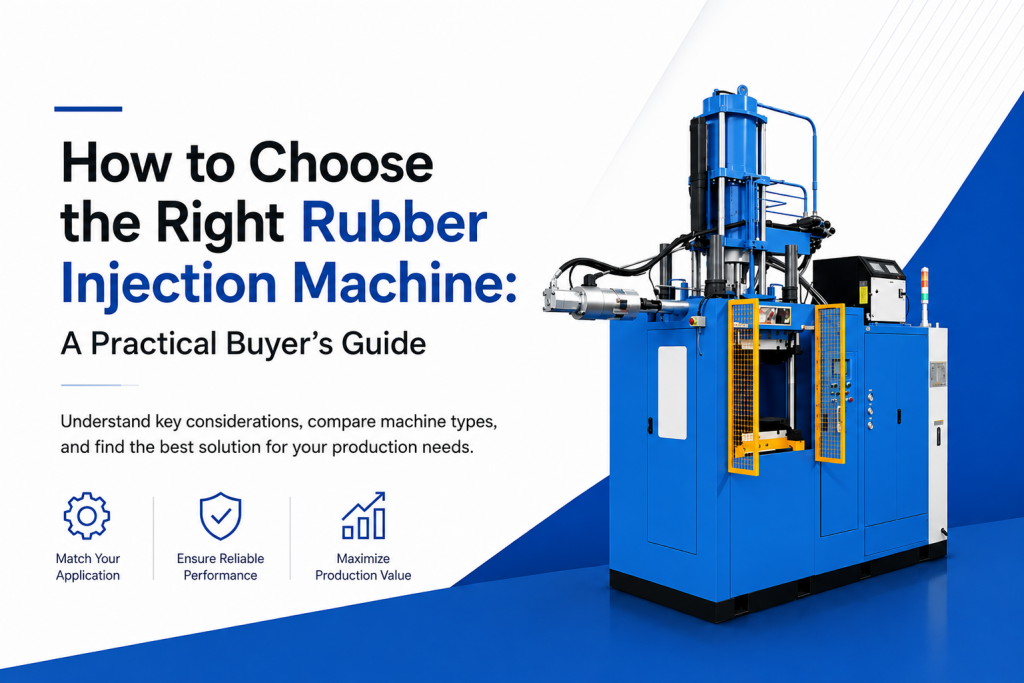
Selecting the right rubber injection machine shapes your production efficiency, product quality, and long-term operating costs. Whether you are new to rubber injection molding or expanding your production capacity, this guide covers everything you need to evaluate — from machine types and key specifications to matching your rubber injection molding equipment to your specific product application.
Three Main Types of Rubber Injection Molding Machines
The market offers three primary machine configurations: vertical, horizontal, and angle/four-column. Understanding the differences between them is the first step in evaluating any rubber injection molding equipment.
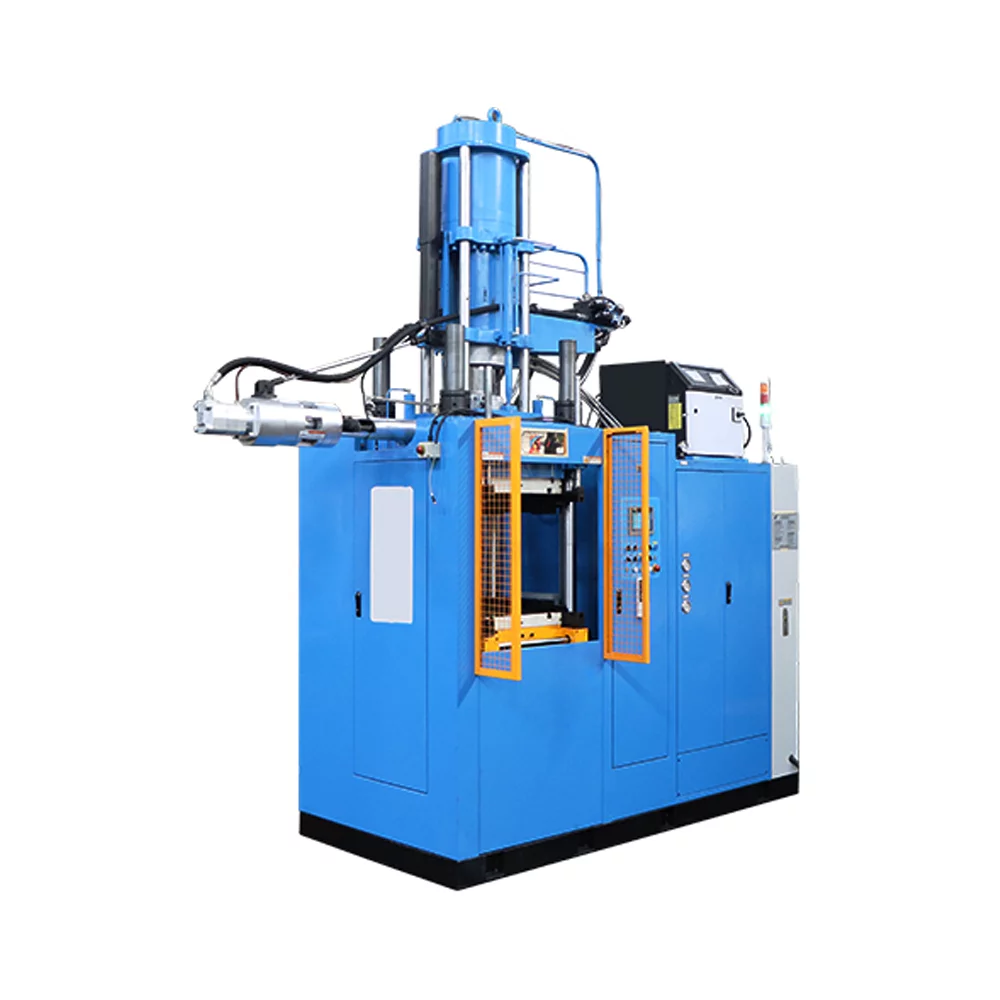
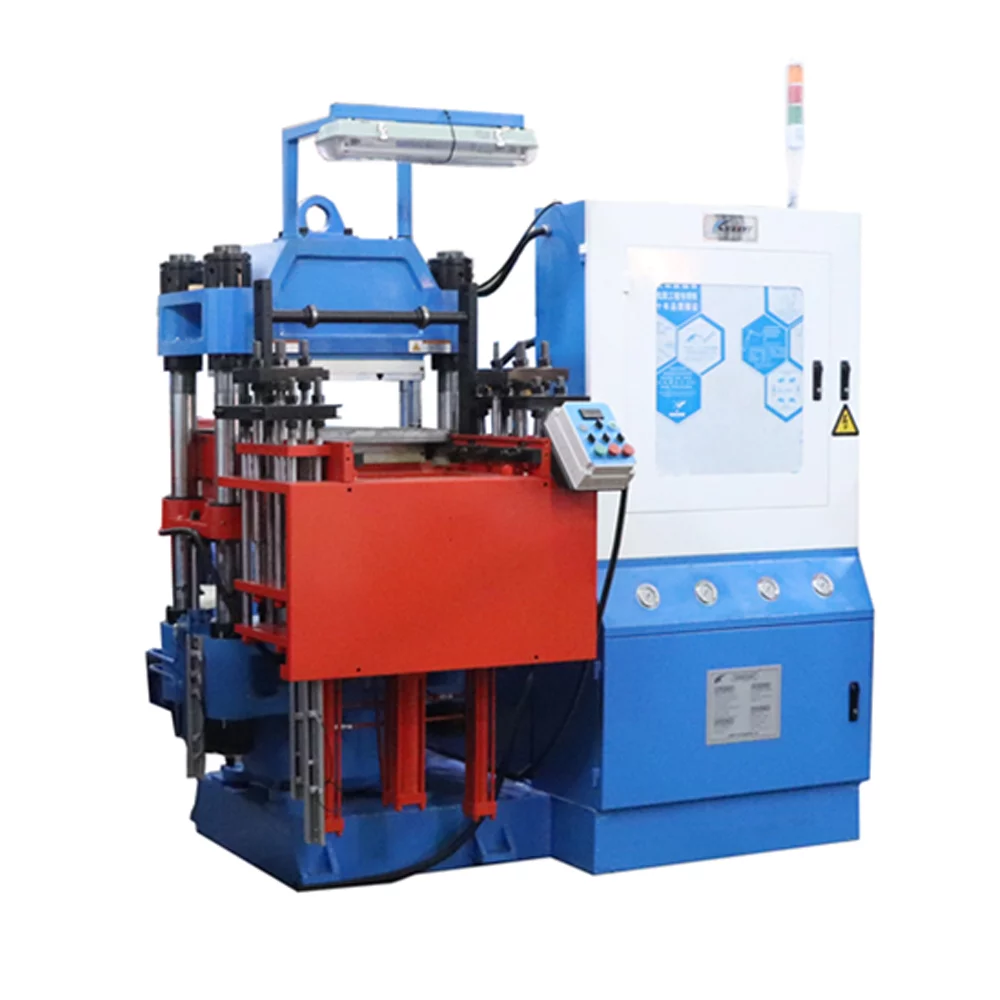
- Vertical machines:have the mold clamping unit and injection unit arranged on a vertical axis. The mold opens and closes vertically, with the injection unit positioned directly above.
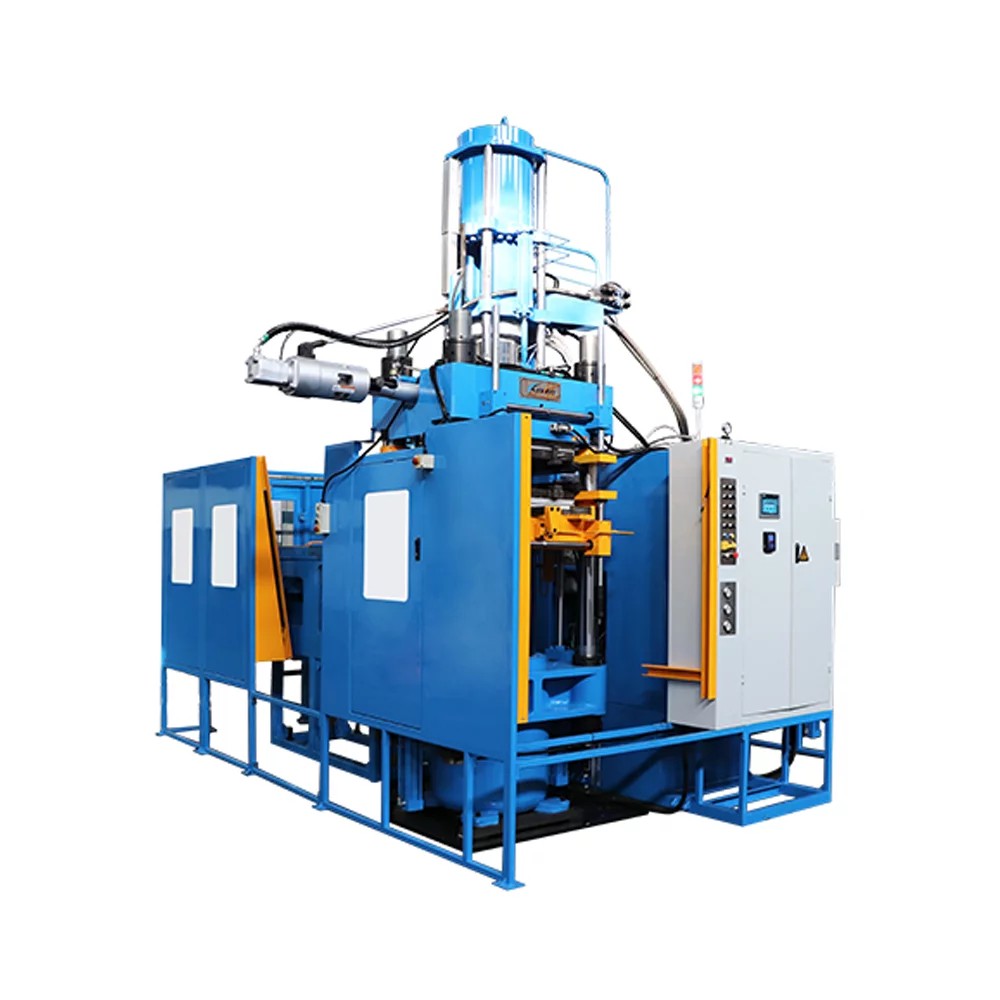
- Horizontal machines:have the clamping and injection units aligned on a horizontal axis. The mold opens and closes in a horizontal direction, making it easy to integrate with conveyor systems and robotic arms.
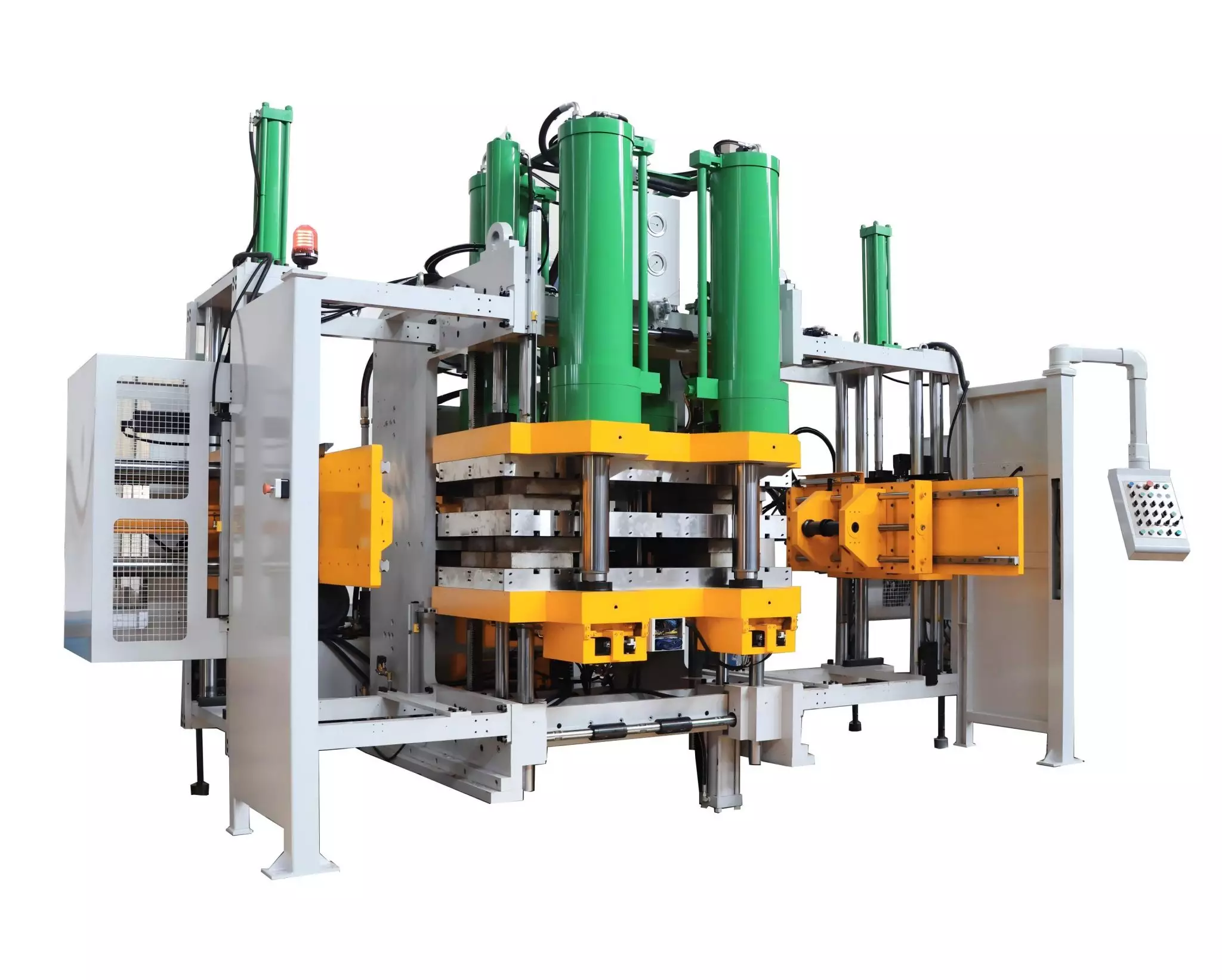
- Angle / Four-Column machines: position the injection unit at an angle relative to the clamping unit, supported by four columns that provide balanced clamping force distribution across the mold. This structure is specifically designed to accommodate large, complex molds.
5 Key Specifications You Must Evaluate
Once you have identified the right machine type, five technical parameters determine whether a specific rubber injection machine is genuinely suited to your production needs.
Clamping Force
Clamping force keeps the mold fully closed during injection. It is calculated by multiplying the projected product area by the injection pressure, with an additional safety margin applied. As a general rule, never select a machine at its minimum clamping capacity. Running a machine at or near its clamping limit under real production conditions leads to flash formation, higher reject rates, and accelerated mold wear. Always leave a safety margin of at least 10 to 20 percent above your calculated requirement[1].
Injection Volume
Injection volume defines the maximum amount of rubber the machine can deliver in a single cycle. It must exceed the total cavity volume of the largest mold the facility intends to run. Industry practice recommends operating with a margin below the machine’s maximum injection volume, rather than at full capacity, to maintain shot consistency. Operating at full capacity reduces process stability and leaves no room for material variation between batches.
Heating Platen Size
Heating platen size refers to the surface dimensions of the heated plates that hold the mold in place. Platen size sets the upper limit for mold dimensions, but temperature uniformity across the platen surface is equally important. A platen with poor temperature distribution can produce deviations of up to 40°C across the surface, leading to uneven vulcanization and inconsistent part quality[2]. Always verify both the physical dimensions and the temperature uniformity specification before committing to a machine.
Mold Thickness Range
Mold thickness range spans the minimum mold thickness the machine accepts to the maximum clamping stroke it can accommodate. This parameter determines how many different mold designs the machine can run without physical modification. A wider range gives the facility flexibility to take on new products and different mold heights without investing in additional equipment, which is particularly important if your product mix is expected to grow.
Control System
The control system covers the PLC and HMI that manage all machine operations, including parameter setting, cycle control, fault diagnostics, and remote communication. For overseas installations, remote diagnostics capability is not optional — it directly determines how quickly a machine can be brought back online after a fault. Industry-standard controllers from Siemens, B&R, or Mitsubishi are widely adopted across professional rubber injection molding facilities and ensure compatibility with downstream automation systems and third-party service networks.
Matching Your Rubber Injection Machine to Your Product
Different product categories have clear equipment implications. Matching your rubber injection machine to your application from the outset prevents costly retrofits later.
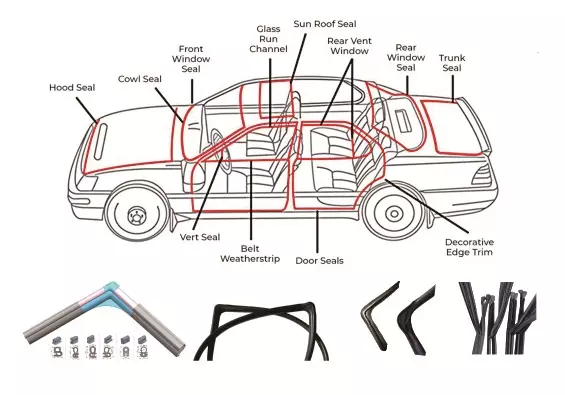
- Automotive rubber parts:seals, bushings, and vibration dampers demand tight cycle consistency and seamless automation integration to meet OEM supply chain requirements. Horizontal machines are the standard choice for this reason.
- Industrial seals and gaskets:O-rings, flat gaskets, and custom-profile seals are produced in high volumes with standardized geometries, making output per cycle the key metric. Vertical machines paired with multi-cavity molds are best suited for this application.
- High-voltage composite insulators and arresters: surge arresters, hollow core bushings, and line post insulators require large injection volumes, extended clamping strokes, and full silicone rubber injection molding compatibility. Only four-column machines provide all three.
- Cable accessories:cable joints, terminations, and surge arresters involve large rubber blocks that standard feeding systems cannot handle. Horizontal machines with open stuffer feeding systems are designed specifically for this requirement.
As a general rule, vertical machines suit high-volume standardized parts, horizontal machines handle automation-intensive and large-block applications, and four-column machines are reserved for technically demanding specialty products that standard configurations cannot support.
Recommended reading: The Complete Guide to Custom Molded Rubber Parts Manufacturing
4 Common Mistakes to Avoid When Buying
Underestimating Clamping Force
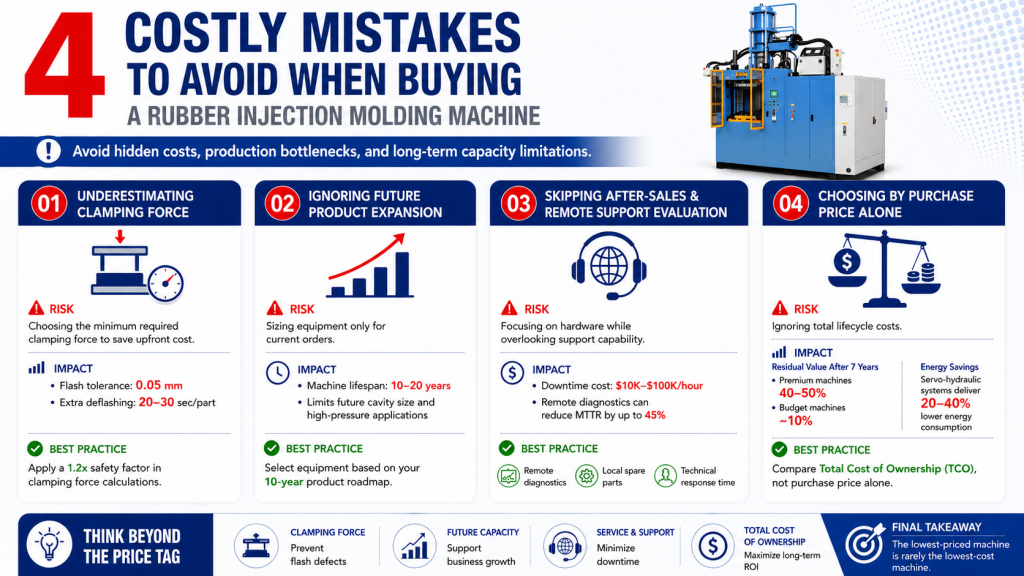
Many buyers select a machine at its minimum clamping capacity to reduce upfront cost. Industry standards limit flash to 0.05 mm for high-precision parts — insufficient clamping force pushes defect rates beyond this threshold, adding costly deflashing labor of 20 to 30 seconds per part. Always apply a 1.2x safety factor to your clamping force calculation to account for material viscosity variations[3].
Ignoring Future Product Expansion
Industrial machines typically have a service life of 10 to 20 years[4], yet many buyers size equipment for current orders only. A machine that fits today’s product line becomes a hard constraint the moment you take on larger cavity volumes or higher-pressure applications. Base your selection on a 10-year product roadmap, not your current order book.
Skipping After-Sales and Remote Support Evaluation
For overseas installations, unplanned downtime can cost anywhere from $10,000 to $100,000 per hour[5]. Modern remote diagnostics can reduce mean time to repair by up to 45% and eliminate over half of unnecessary site visits[6]. Remote support capability and local spare parts availability should be evaluated as part of the total purchase decision, not treated as secondary concerns.
Choosing the Purchase Price Alone
A low purchase price often conceals significant lifecycle costs. High-quality rubber injection molding equipment typically retains 40 to 50 percent of its value after seven years, while budget machines may retain as little as 10 percent[7]. Servo-hydraulic machines carry a higher upfront cost but deliver 20 to 40 percent energy savings over standard hydraulic units[8]. Total cost of ownership is the only accurate metric.
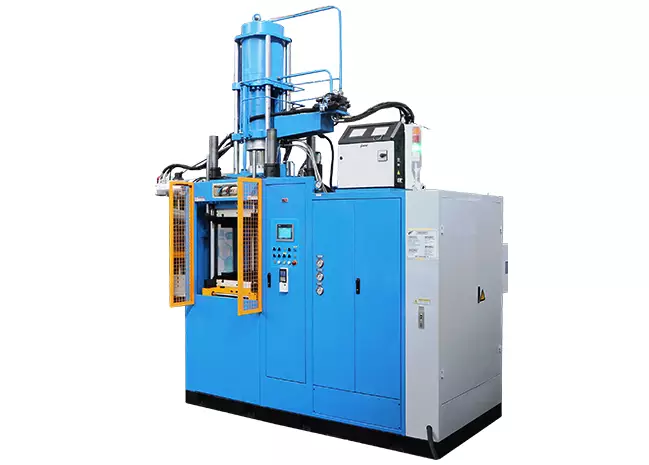
A Recommended Solution: The HYZ-E Series Rubber Injection Machine
For facilities producing precision rubber components at volume, the HYZ-E Series delivers the operational reliability that serious rubber injection molding demands.
- Four-column vertical structure: provides high durability, stability, and platen parallelism throughout the clamping cycle.
- Precise temperature control: platen temperature tolerance within ±2°C, with PID calibration and German-imported insulation plates to minimize heat loss.
- PLC production management: monitors the entire production process with support for 300 saved production recipes and USB data transmission.
- Optional HTV silicone rubber feeder: supports silicone rubber injection molding for insulators, arresters, cable joints, bushings, and other cable accessories.
- CE standard option:available for facilities supplying European markets or operating under international compliance requirements.
Whether you are producing automotive seals, industrial gaskets, or high-performance silicone components, the HYZ-E Series is built to meet the demands of professional rubber injection molding equipment at scale.
Find the Right Rubber Injection Machine for Your Production Line
Selecting the right rubber injection machine comes down to understanding your product requirements, matching the correct machine type, and evaluating specifications beyond the purchase price. If you are ready to take the next step, Hwayi’s engineering team is available to help you identify the right configuration for your application. Contact us today to get started.
References
- https://tatming.com.cn/wp-content/uploads/2020/03/How-to-select-an-injection-moulding-machine.pdf
- https://www.igminresearch.com/articles/a-pdf/igmin304.pdf
- https://evokpoly.com/feeds/blog/flash-injection-molding
- https://essay.utwente.nl/fileshare/file/81541/Denekamp_MA_BMS.pdf
- https://essay.utwente.nl/fileshare/file/81541/Denekamp_MA_BMS.pdf
- https://www.aftersale.one/blog/how-remote-diagnostics-reduce-downtime-in-heavy-machinery
- https://www.sherpaminiloaders.com/wp-content/uploads/2026/01/Whitepaper-TCO-ROI-ENG.pdf
- https://www.acomold.com/electric-vs-hydraulic-injection-molding-machine.html